
Hello,
While the vast majority of my consultations with clients focus on the issues most immediately relevant to their lives, I remain keenly interested in the correlations between astrological and geopolitical events, the branch of astrology known as mundane astrology. In this article, I will briefly outline three trends that I view as pertinent to the war that began on February 28th. I have cast charts for the US and Iran, and the aspects that I will describe apply to all involved parties. As one of these trends is about to be reactivated, I thought that this would be a good time to share my thoughts. Lastly, all dates in the text are in MST.
Best,
Elizabeth
Mercury Retrograde
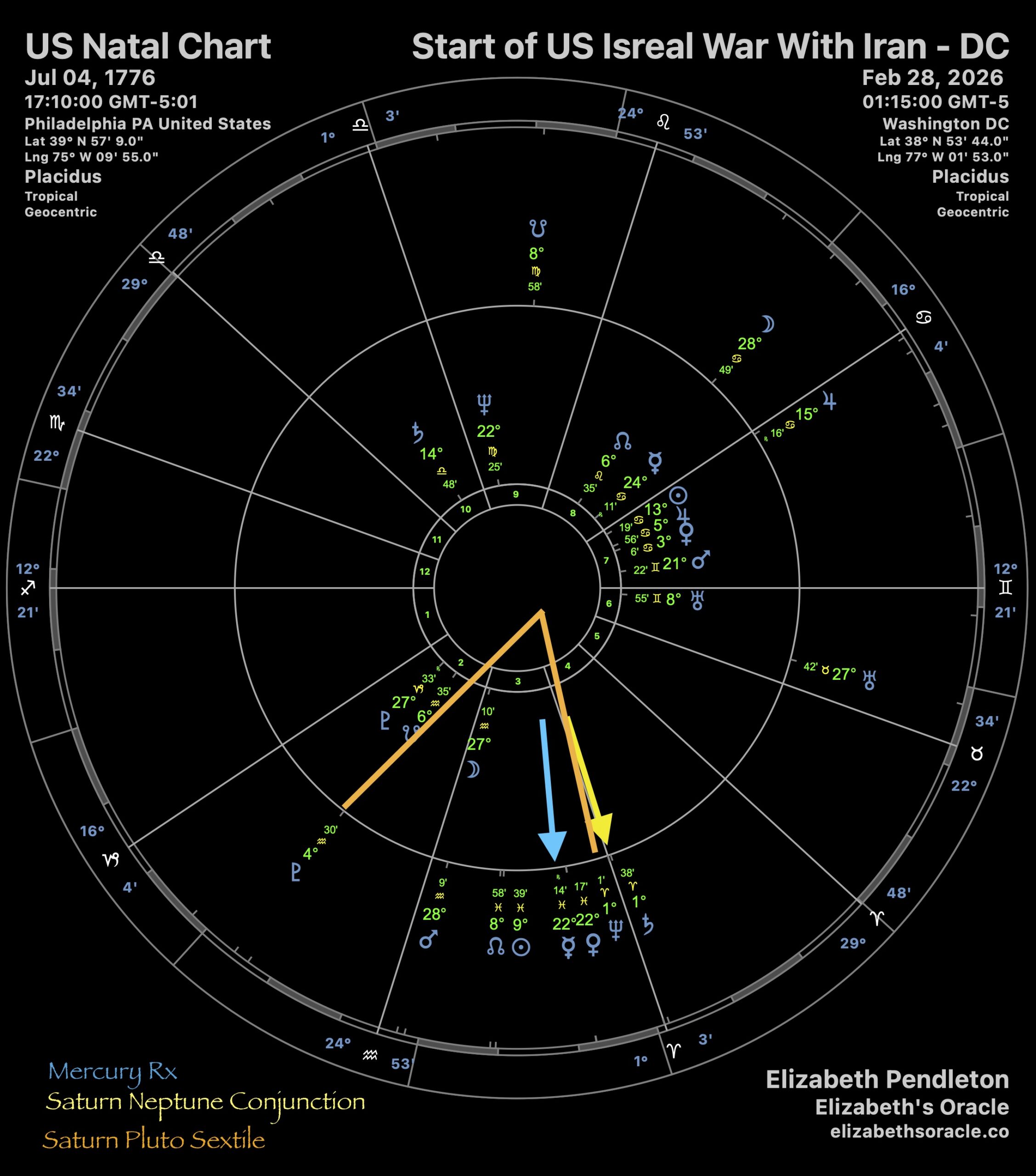
Even those who dismiss astrology entirely are likely to be familiar with the notorious Mercury Retrograde. The planet of technology, commerce and communication, Mercury goes retrograde three to four each year. These time periods are associated with delays, mishaps and stymied plans. In 2026, all three Mercury retrogrades are in astrology’s water signs. To date, each of the year’s Mercury retrogrades have aligned with impediments to navigation in a critical global waterway.
February 26 to March 20th in Pisces
Pisces is astrology’s mutable water sign. It is characterized by ambiguity, boundlessness and instability. Ancient astrologers considered Mercury to be in the sign of its fall (opposite of its exaltation) when in Pisces. Modern astrologers assign rulership of Pisces to the planet Neptune, and it is associated with illusion, deception and unreliability. When the war began, Iranian officials were in negotiations aimed at resolving outstanding issues between Iran and the US. On the 28th and allegedly due to faulty intelligence, the US bombed a primary school in the city of Minab, killing 168 people, mostly children. The Ayatollah Khamenei and members of his immediate family were also wounded and killed in those initial US and Israeli strikes. Iran responded militarily and by seizing control of the Strait of Hormuz. Until the war began, approximately 20% of the world’s oil supply was shipped through that strait.
June 29th to July 23rd in Cancer
This period includes the abandonment of the Memorandum of Understanding (MOU), the attendance of the funeral of the Ayatollah Khamenei by millions of mourners and a consequential attack on the Sanaa International Airport by Saudi Arabia. Dignitaries from Ansar Allah/the Houthis were returning from the Ayatollah’s funeral when the Saudis bombed the runway that the Yemenis were attempting to use for landing. That incident is now widely viewed as the catalyst for the restart of the war between the Saudis and Houthis. Up to that point, Saudi Arabia, whose economy is heavily dependent of profits from oil, had been able to use the Bab el-Mandeb Strait as a shipment alternative to the SOH. Following the airport bombing, the Houthis effectively stopped Saudi oil shipments from moving through the Bab el-Mandeb Strait, adding more pressure to global oil supplies.
October 24th to November 13th in Scorpio
Ancient or traditional astrologers consider Mars to be the ruler of the fixed water sign, while modern astrologers assign Scorpio’s rulership to Pluto. Mars is associated with aggression, battle and conquest, and Pluto with destruction, death and purification. The sign’s fixed modality adds an intransigent quality to its character, making it the least flexible of the water signs. This retrograde’s timeframe will coincide with elections in Israel (a co-belligerent in the war) and in the US. Reports of the militaries in Iran and Israel being on high alert and of a large buildup of US forces in the region are circulating as I edit this article on October 16th. Given the nature of Scorpio and Mercury’s reputation for double-dealing, this one looks like the most ominous of the year’s retrogrades.
Saturn Neptune Conjunction
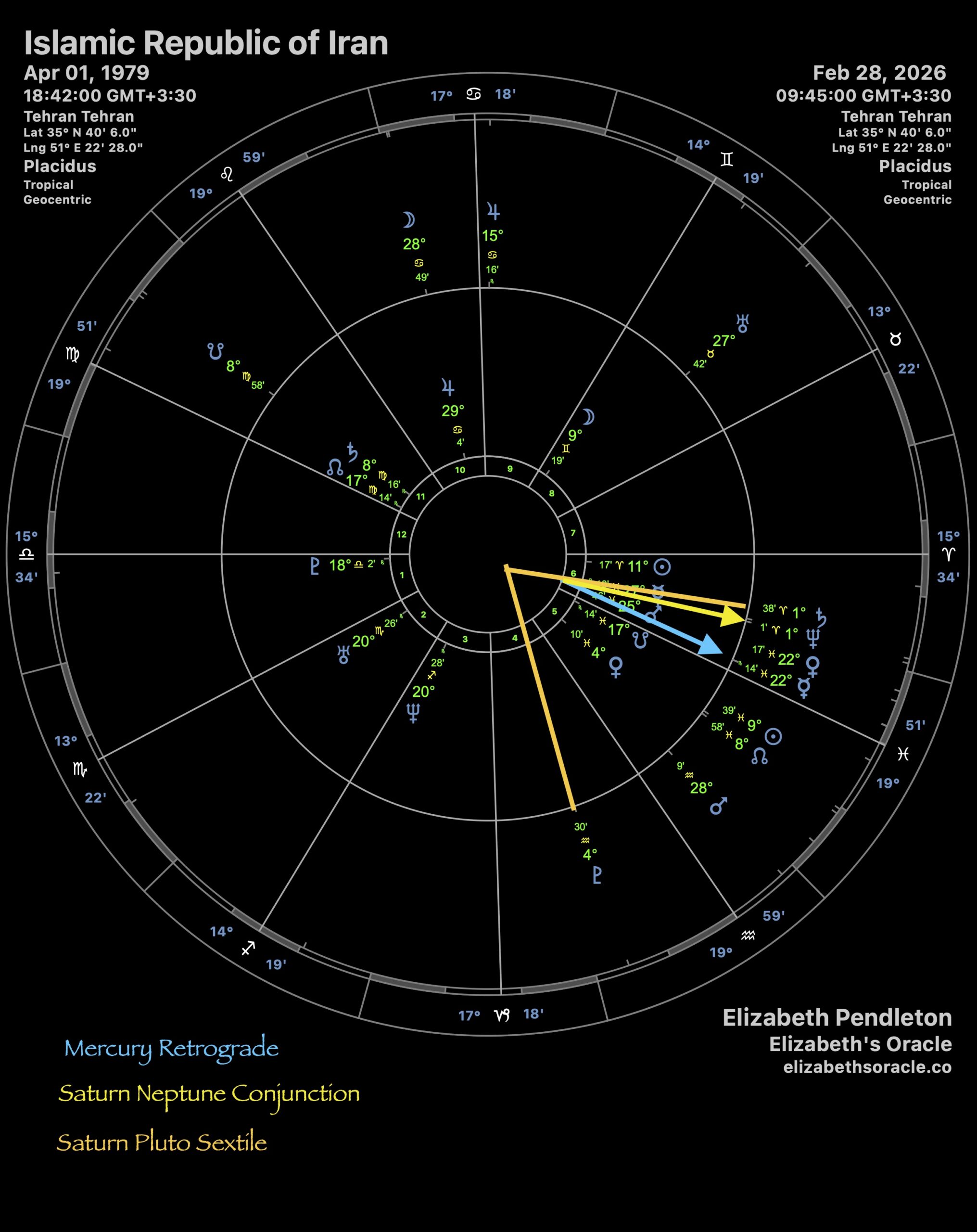
The outer planets Uranus, Neptune and Pluto are associated with events of global magnitude, and their connections play out over months and years. On February 20th, Saturn and Neptune conjoined for the first time since 1989. That year the Berlin Wall fell and the world wide web was invented. At that time, it would have been nearly impossible to accurately predict the full extent of the impact of those two events. In 2026, the two planets met at 0º Aries 45′. Aries is the cardinal fire sign of initiation, and zero is the first degree in astrology. Translation; we are at the beginning of consequential changes in international relations, alliances and commerce. Astrologers anticipated an event of worldwide import around the time of this conjunction, and the war appears to be the first obvious paradigm changer in its wake.
Saturn Pluto Synodic Cycle
On January 12, 2020 Saturn conjoined Pluto. The Millennial generation on down will recall the hashtag #Tarnaswasright populating social media as news of COVID emerged from the fringes of international news coverage into the American mainstream. Richard Tarnas is the Harvard educated, best-selling author of “Cosmos And Psyche”. In that sentinel work, Tarnas correlated outer planet transits and connections with impactful social, political and cultural events through five centuries of Western history. On March 28, 2026 Saturn and Pluto formed the waxing sextile of the cycle they began in January 2020. This was the first meaningful meeting point in the cycle that will last until March 2054.
As a full-time astrologer, that someone started a war during a Mercury retrograde, in Pisces no less, would be laughable if it wasn’t so tragic. Most in my field were on the lookout for a major event sometime around February 2026 due to the Saturn Neptune conjunction. But it was the recognition of this next critical point in the Saturn Pluto synodic cycle that stuck me the most. Like COVID, current events will ultimately resolve. But my gut, and the planets, tell me that we are only at the beginning of seismic and difficult changes to the world as we know it.